Facebook
 X
 Pinterest
 Copy Link
Local Real Estate Market Update: November 2026

Over the past several months, there have been plenty of questions about what it will take to get the Windsor-Essex real estate market moving again. High interest rates, concerns about the economy and local jobs, and uncertainty about the future have made many buyers and sellers hesitant to make a move.
The reality is, there isn’t one single event or announcement that’s likely to change the market overnight. Instead, several factors are working together to shape the Windsor-Essex real estate market.
Where Does the Market Stand?
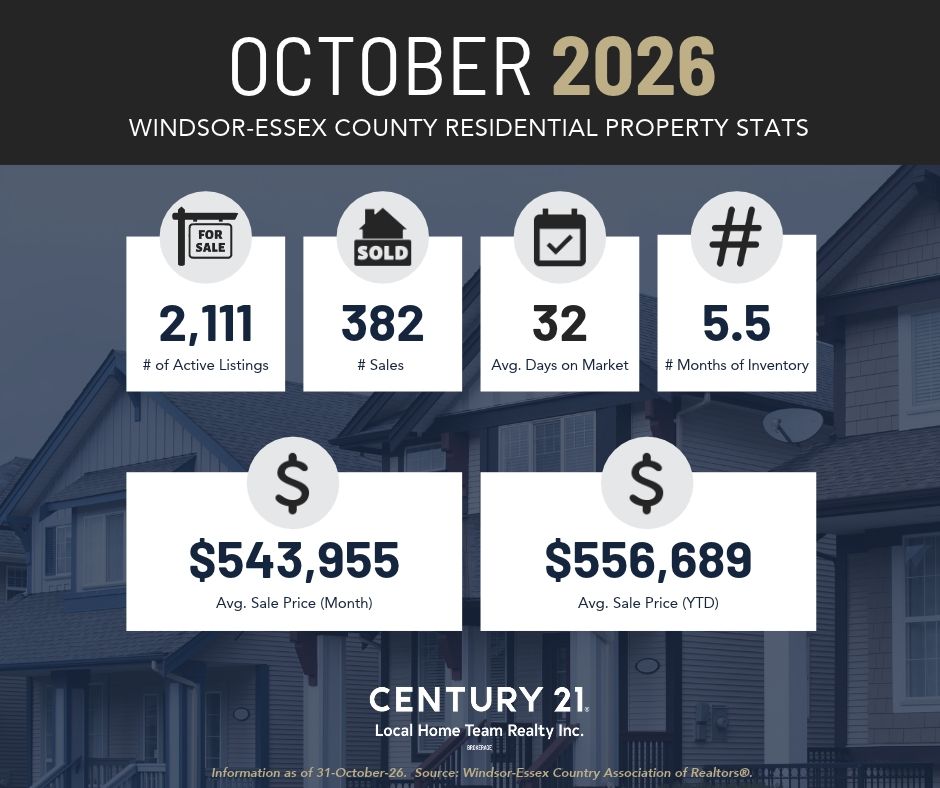
Looking at the year-to-date numbers, local real estate activity remains below where it was this time last year.
Here’s where Windsor-Essex currently stands:
- New listings are down 5%.
- Home sales are down 7%.
- Average sale prices are down 3%.
These numbers reflect a market that has softened, with buyers and sellers taking a cautious approach to their real estate decisions.
However, a slowdown in activity doesn’t mean there are fewer opportunities.
A Different Market, With New Opportunities
One of the more encouraging developments is that housing affordability has improved compared to the recent years. Lower home prices, a more balanced market and HST savings on qualifying new builds have created more opportunities for buyers.
For those who have been waiting for the right time to enter the market, there are some advantages worth considering.
- For buyers, there is more choice, more room to negotiate and less pressure to make quick decisions. Buyers have more time to explore their options, compare homes and find the right fit.
- For sellers, having the right approach is key. Knowing the market, preparing your home for sale and setting the right price are more important than ever. Homes that are well-priced and stand out from the competition are better positioned to attract serious buyers.
What Does This Mean Moving Forward?
While it’s natural to look for a turning point in the market, real estate conditions rarely change overnight. In fact, buyer and seller activity will continue to be shaped by consumer confidence, the economy, local jobs and interest rates in the months ahead.
At the same time, we’re seeing a return to a more balanced market. Buyers and sellers are making choices based on home values. Instead of reacting to fast price increases like we saw during COVID, they’re focusing more on their long-term needs.
Making the Most of Today’s Market
A slower market isn’t necessarily a bad market.
Rather, it means buyers and sellers need to approach their decisions with a better understanding of what’s happening locally. By taking the time to understand current conditions, both can make choices that better suit their needs.
So, is the market waiting for something to change? Perhaps. However, in the meantime, buyers and sellers are adapting to changing conditions and shaping a new real estate landscape across Windsor-Essex. Ultimately, rather than waiting for the “perfect” market, taking the time to understand today’s conditions is the best place to start.

Cody Kraus
Broker | Owner
c: 519.322.7105
e: cody.kraus@century21.ca
The information provided on this blog is not intended as professional advice and should not be substituted for the guidance of a qualified professional. While we strive to provide accurate and up-to-date information, we make no representations or warranties of any kind, express or implied, about the completeness, accuracy, reliability, suitability, or availability with respect to the blog or the information, products, services, or related graphics contained on the blog for any purpose. Any reliance placed on such information should be independently verified.
7 Essential Fall Prep Tips To Get Your Home Winter Ready

As the seasons change and the leaves begin to turn, fall is the perfect time to give your home a little extra attention. With cooler temperatures approaching, a few simple fall prep tips can help protect your property, improve comfort, and prepare your home for the months ahead.
Whether you’re planning to stay in your home for years to come or considering a move in the near future, taking care of these seasonal details can make a difference.
1. Inspect Your Roof and Gutters
Your roof and gutters play an important role in protecting your home from the elements. Before the heavy rain and snow arrive, take a moment to check for missing or damaged shingles, clogged gutters, and downspouts that may not be directing water away from your foundation. Clearing away leaves and debris can help prevent water buildup and reduce the risk of damage during the colder months.
2. Have Your Furnace Serviced
A comfortable home starts with a reliable heating system. Fall is a great time to schedule furnace maintenance, replace your furnace filter, and make sure your heating system is ready for the colder weather. It’s also a good opportunity to check your smoke and carbon monoxide detectors and replace batteries if needed.
3. Seal Drafts Around Windows and Doors
Small drafts can make your home feel colder and may increase heating costs. Check the weatherstripping around exterior doors and inspect windows for gaps or worn seals. Simple improvements, such as replacing damaged caulking or adding draft protection, can help make your home more comfortable throughout the winter.
4. Prepare Your Outdoor Spaces
Fall is the time to start preparing your yard for the colder season. Put away outdoor furniture, clean up leaves, and trim back plants as appropriate. If you have a pool, make sure your seasonal closing is completed properly and that your equipment is protected. Taking care of these tasks now can help prevent unnecessary repairs when spring arrives.
5. Tackle Small Repairs Before They Become Bigger Problems
That dripping faucet, loose handrail, or small crack in the driveway may not seem urgent, but fall is a good time to address minor repairs before winter weather makes them more difficult. A little preventative maintenance can help preserve your home’s condition and keep your future to-do list from growing.
6. Declutter and Organize Your Home
As we spend more time indoors, fall is an ideal season to organize closets, mudrooms, and storage areas. Consider donating items you no longer use and creating a designated space for boots, coats, and seasonal gear. A tidy home feels more comfortable for your family and makes everyday living a little easier.
7. Take a Fresh Look at Your Home’s Curb Appeal
Your home’s exterior makes a lasting first impression. Even simple updates, such as refreshing the front entrance, adding seasonal planters, or ensuring walkways are clean and well-maintained, can help your property feel inviting. If you’re thinking about selling in the coming months, these small details can also help create a welcoming first impression for potential buyers.
Fall is more than a season of change. It’s also a great time to reflect on your home and your future real estate goals.
If a move might be on your horizon, I’d be happy to help you explore your options. Whether you’re thinking about buying, selling, or simply curious about your home’s current value, reach out anytime… I’m always happy to chat!

Stacey Jones
Real Estate Agent
c: 519.984.6007
e: stacey.jones@century21.ca
The information provided on this blog is not intended as professional advice and should not be substituted for the guidance of a qualified professional. While we strive to provide accurate and up-to-date information, we make no representations or warranties of any kind, express or implied, about the completeness, accuracy, reliability, suitability, or availability with respect to the blog or the information, products, services, or related graphics contained on the blog for any purpose. Any reliance placed on such information should be independently verified.
Local Real Estate Market Update: October 2026

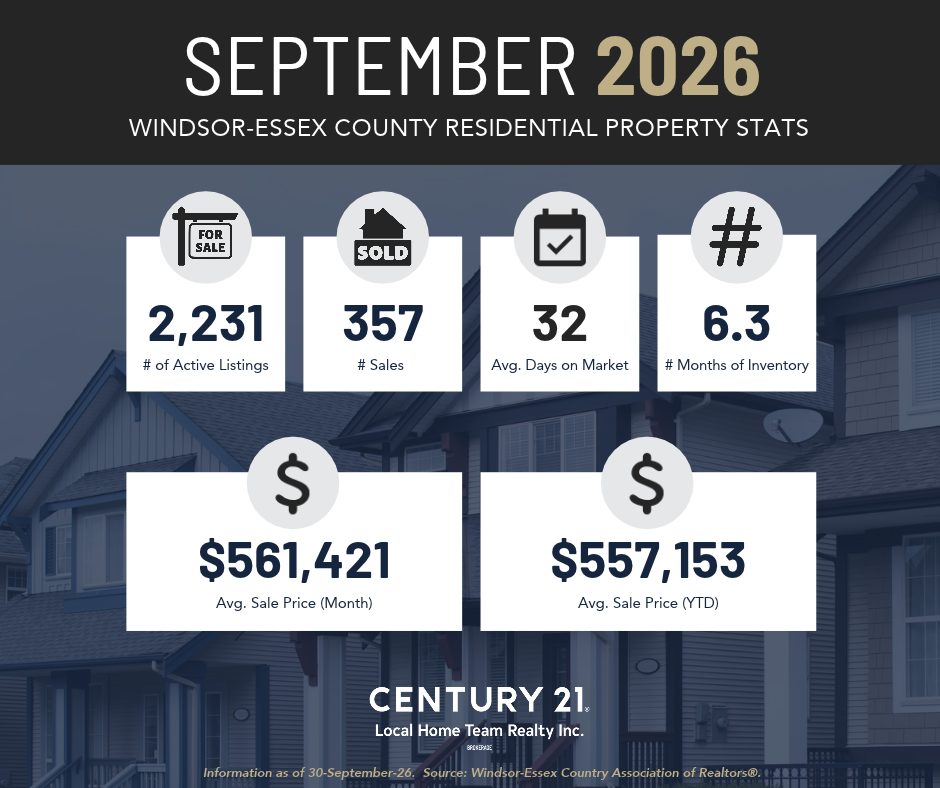
The 3rd quarter of 2026 is officially in the rearview and we are in the final stretch of the year. Our Windsor-Essex real estate market continues to look a lot like what we’ve experienced over the past 3 years.
Overall, we’re in a balanced market.
While that might not sound particularly exciting, there’s actually a lot of opportunity in today’s market. It means buyers and sellers can make decisions based on data rather than emotion, with conditions in place to help protect both sides. The Windsor-Essex real estate market is showing different conditions depending on the price point and property type.
It’s All About the Price Point
When we break things down, the market looks a little different depending on what you’re buying or selling.
Right now, we’re seeing a seller’s market for properties under $600,000. While properties over $600,000 and condos are generally in a buyer’s market.
That creates some interesting opportunities for households who are thinking about making a move.
Where Are the Opportunities?
Move-Up Buyers:
If you’re selling an entry-level home and moving into a mid-range or higher-end property, you may benefit on both sides of the transaction. You can potentially sell into a stronger segment of the market plus take advantage of more favourable conditions on your next purchase.
Downsizers:
For homeowners looking to move from a single-family home into a condo or rental, today’s market can also create an opportunity. Selling your existing home while having more negotiating power on your next property can make the transition much more manageable.
New Construction:
Buyers considering new builds under $1 million can benefit from the current HST exemption, making new construction more attractive.
Real Estate Investors:
Investors are facing considerably less competition for rental properties than we’ve seen in previous years. This creates opportunities to find better value in the market. At the same time, Landlord and Tenant Board wait times are improving, along with some investor-friendly revisions to LTB matters.
The Bottom Line
The market may not be moving at the pace we saw during the busier years. But that doesn’t mean there aren’t opportunities.
In fact, a more balanced market gives the ability to make strategic decisions rather than rushed ones.
Understanding the Windsor-Essex real estate market plus knowing where the opportunities are and how to take advantage of them is key.
Having the right information can make all the difference.
Cody Kraus
Broker | Owner
c: 519.322.7105
e: cody.kraus@century21.ca
The information provided on this blog is not intended as professional advice and should not be substituted for the guidance of a qualified professional. While we strive to provide accurate and up-to-date information, we make no representations or warranties of any kind, express or implied, about the completeness, accuracy, reliability, suitability, or availability with respect to the blog or the information, products, services, or related graphics contained on the blog for any purpose. Any reliance placed on such information should be independently verified.
How to Know When It’s Time to Move

For many of us, our first home holds a special place in our hearts. For us, it was a tiny two-bedroom, one-bath home in Walkerville. It was a cute little place with a detached garage and parking off the alley. We started renovating the day we moved in and didn’t stop for seven years. We threw parties, hosted Christmas gatherings, and there always seemed to be something going on. At that stage of our lives, it was perfect.
But like most things, time moves on and life changes.
When we found out we were expecting our son, suddenly things like family, daycare and school districts became much more important. We also knew our tiny home wasn’t going to meet the needs of our growing family. We still loved the house. It just wasn’t the right home for where our lives were headed.
Sometimes the question isn’t: “Do I still like my house?” It’s: “Does this house still work for the life I’m living now?”
Those are two very different questions.
Your Life Changed. Your House Didn’t.
Most of us buy a home based on what makes sense at a particular stage of life. A young couple may want room for a growing family. Years later, the kids move out and suddenly there are empty bedrooms, a large yard and much more house than they need. Or the opposite happens. That perfect starter home now has kids, pets, sports equipment, a home office and nowhere to put anything. The house didn’t become a bad house. Your life simply changed around it.
Here are a few signs it may be worth thinking about what comes next.
1) You’re Trying to Make the House Something It Isn’t
There’s nothing wrong with renovating. But if you’re constantly talking about adding bedrooms, changing the entire floor plan, creating another bathroom, building an addition or eliminating stairs, it may be worth asking: Are we improving this house, or trying to turn it into a completely different house?
Before investing heavily in renovations, compare the cost with what moving to a home that already fits your needs might look like.
2) You’re Paying for Space You Don’t Use
Maybe the kids have moved out. One bedroom stores Christmas decorations. Another rarely gets used. The formal dining room sees people twice a year. Meanwhile, you’re still heating, cooling, cleaning and maintaining all of it. Downsizing doesn’t have to mean giving something up.
For some homeowners, less house can mean:
- less maintenance
- fewer stairs
- lower expenses
- more travel
- a better location
- more time for the things they actually enjoy
Sometimes less house creates more lifestyle.
3) Your Location No Longer Fits Your Life
A neighbourhood that made perfect sense 15 years ago may not make sense today. Maybe you originally bought close to work or your children’s school. Now you’d rather be closer to family, shopping, restaurants, medical services or the places you actually spend your time. A house can still be wonderful while its location no longer works for your everyday life.
4) Maintenance Has Become a Burden
Homeownership comes with work. Grass needs cutting. Snow needs clearing. Gardens need attention. Roofs, windows and furnaces eventually need replacing. For some people, that’s part of the enjoyment. For others, there comes a point when they realize: “I don’t want to spend my weekends doing this anymore.” That doesn’t automatically mean moving to a condo. It simply means maintenance should become part of the conversation when thinking about your next stage of life. There is real value in getting your time back.
5) Your Future No Longer Fits the House
One of the best questions you can ask isn’t whether your home works today. It’s whether it will still work five or ten years from now.
Are you planning to retire?
Will stairs eventually become an issue?
Do you want to travel more?
Will the kids be leaving home?
Would you like to live closer to family?
Do you expect to work from home?
Good real estate decisions often begin long before the For Sale sign goes on the lawn.
But Moving Isn’t Always the Answer
Sometimes the right answer is to stay exactly where you are. A renovation may solve the problem. Hiring someone to handle the yard might make the house enjoyable again. And sometimes, after looking at what else is available, homeowners realize they already have exactly what they want. That’s valuable information too. The goal isn’t to convince yourself to move. The goal is to understand your options.
Ask Yourself These Five Questions
- If I were buying a home today, would I choose this one again?
- What frustrates me most about living here?
- Can those frustrations realistically be fixed?
- What do I want my life to look like five years from now?
- Would a different home make that lifestyle easier?
Your answers may tell you more than you expect.
Sometimes the First Step Isn’t Selling
Talking to a REALTOR® shouldn’t automatically mean putting your home on the market. Sometimes the most useful first step is simply understanding:
- what your current home may be worth
- what other homes are available
- what buying and selling would cost
- whether renovating or moving makes more sense
- what your next home would actually need to provide
Once you know those things, the decision becomes much easier. You may decide to move. You may decide to renovate. You may decide to stay for another few years.
All three can be good decisions.
The Bottom Line
There doesn’t have to be anything wrong with your house for it to stop being the right home. Our homes are tied to different stages of life. And eventually, sometimes, life moves forward before the house does. If you’ve started wondering whether your current home still fits where you’re headed, you may not need a For Sale sign. You may just need a conversation.
Relationships First. Real Estate Second.

Len Filiault
Broker of Record
c: 519.890.5045
e: len.filiault@century21.ca
The information provided on this blog is not intended as professional advice and should not be substituted for the guidance of a qualified professional. While we strive to provide accurate and up-to-date information, we make no representations or warranties of any kind, express or implied, about the completeness, accuracy, reliability, suitability, or availability with respect to the blog or the information, products, services, or related graphics contained on the blog for any purpose. Any reliance placed on such information should be independently verified.
10 Reasons to Attend the Windsor-Essex Economic Summit

There’s no shortage of headlines about Canada’s economy.
Interest rates. Inflation. Housing. Trade. Investment. Economic growth. Every day seems to bring a new prediction about where things are headed next.
But as we begin looking ahead to 2027, understanding the bigger picture (and separating the headlines from the trends that really matter) is becoming increasingly important.
On September 22, the Windsor-Essex Economic Summit will bring Ben Rabidoux and Richard Dias to Caesars Windsor for a morning of economic insights, thoughtful discussion and a live audience Q&A.
Still wondering if the event is for you? Here are 10 reasons to attend the Windsor-Essex Economic Summit…
1. Hear Directly from the Experts
Skip the sound bites and hear directly from two of Canada’s leading economic voices.
Ben Rabidoux and Richard Dias are known for taking complex economic data and trends and putting them into context… helping audiences better understand not only what is happening, but why it matters.
2. Get Informed Heading Into 2027
What should businesses, investors and individuals be paying attention to as we approach a new year?
The morning will provide perspective on the trends shaping Canada today and what could influence the economy in the months ahead.
3. Understand Where Interest Rates May Be Headed
Interest rates affect far more than mortgages.
They influence borrowing, consumer spending, business investment, development and the broader economy. Gain greater context around the factors influencing rates and what we should be watching next.
4. Get a Clearer Picture of Canada’s Economy
Go deeper into the forces shaping the Canadian economy, from inflation and productivity to economic policy, growth and broader global influences.
It’s an opportunity to step away from the daily news cycle and look at how the pieces fit together.
5. Get the Real Story on Housing
Go beyond the headlines and dig into the data shaping Canada’s housing market.
Whether or not you work in real estate, housing has significant implications for our economy, communities, businesses and household finances.
6. Understand What It Means for Southern Ontario
National statistics only tell part of the story.
Connect the broader economic trends to what’s happening closer to home and consider what they could mean for Southern Ontario and our local communities.
7. Ask Your Own Questions
Have something you want to ask?
The Windsor-Essex Economic Summit will include a live audience Q&A, giving attendees an opportunity to ask questions and hear directly from Ben and Richard.
8. Connect with Local Professionals
The Summit brings together business owners, entrepreneurs, investors and professionals from across the region.
Beyond the presentations themselves, it’s an opportunity to meet, connect and have meaningful conversations with others who are thinking about many of the same issues.
9. Expert Insights, Close to Home
Access the calibre of speakers you’d typically travel to a major conference to hear without leaving Windsor–Essex.
Bringing these conversations closer to home makes high-level economic insight more accessible to our local business community.
10. Start 2027 Better Informed
You don’t need to be an economist to benefit from understanding the forces shaping our economy.
Gain the insights and perspective to help you make more informed decisions and position yourself for success in the year ahead.
Join Us on September 22 | Tickets Available HERE!
The Windsor-Essex Economic Summit takes place Tuesday, September 22 at Caesars Windsor and includes breakfast, presentations from Ben Rabidoux and Richard Dias, and a live audience Q&A.
Whether you’re a business owner, entrepreneur, investor, local professional (or simply someone who wants to be better informed heading into 2027), we hope you’ll join us.
Go beyond the headlines. Hear directly from the experts.
Cody Kraus
Broker | Owner
c: 519.322.7105
e: cody.kraus@century21.ca
The information provided on this blog is not intended as professional advice and should not be substituted for the guidance of a qualified professional. While we strive to provide accurate and up-to-date information, we make no representations or warranties of any kind, express or implied, about the completeness, accuracy, reliability, suitability, or availability with respect to the blog or the information, products, services, or related graphics contained on the blog for any purpose. Any reliance placed on such information should be independently verified.
Local Real Estate Market Update: September 2026

September is here, the kids are heading back to school, and we’re entering what is traditionally the second busiest season for real estate.
So, where does the Windsor-Essex real estate market stand heading into fall?
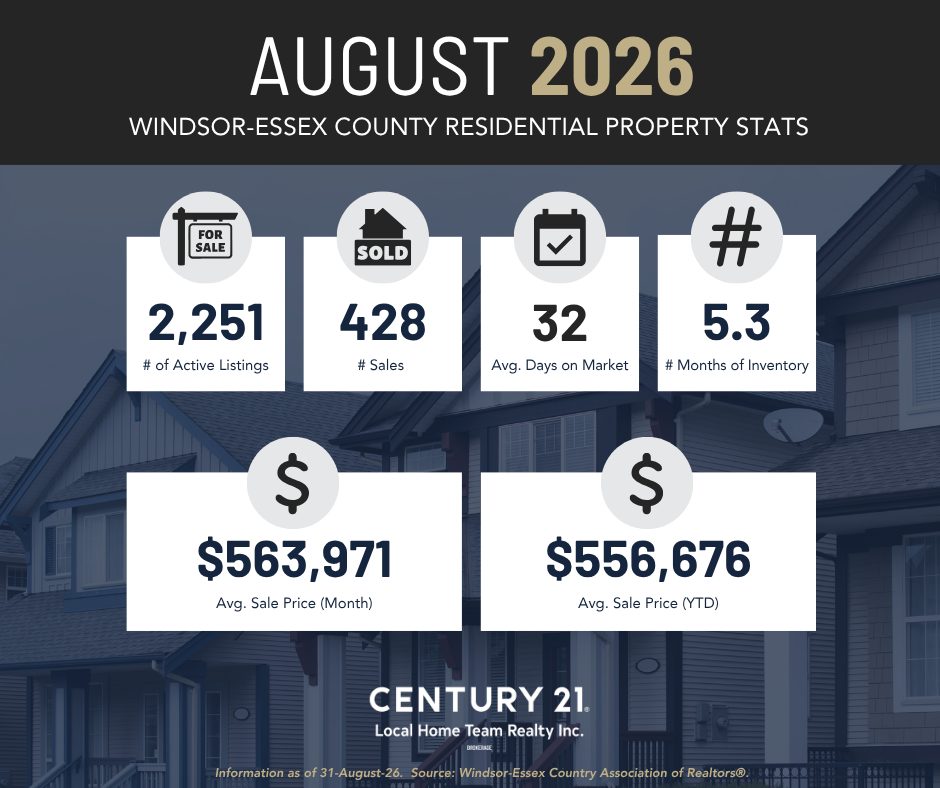
Our latest infographic provides a snapshot of supply and demand based on what happened throughout August.
Sales dropped approximately 8% during the month, while new listings declined by roughly 3%. With sales falling faster than new inventory, months of inventory increased slightly from 4.9 to 5.3 months.
Meanwhile, pricing continues to hold relatively firm. The average sale price for the year is sitting at approximately $564,000.
Rates Hold Steady
The Bank of Canada held its policy rate at its September meeting, adding another element of stability as we head into the final few months of 2026.
At this point, it’s reasonable to expect more of the same from the Windsor-Essex real estate market through the remainder of the year: relatively steady inventory and fairly flat pricing.
But that doesn’t necessarily mean a quiet fall.
Could We See a Busier Fall Market?
There’s a case to be made that we could see the number of transactions begin to pick up without a corresponding increase in home prices.
Sales are currently down approximately 5% year-to-date compared with 2025, and last year was already a lower-transaction year compared with years prior. At the same time, our local population hasn’t declined at the same pace.
People still need to move. Families grow, jobs change, relationships change, and buyers who have been sitting on the sidelines eventually re-enter the market.
That could create some pent-up demand and translate into a busier fall for the Windsor-Essex real estate market, even if pricing remains relatively flat.
As always, we’ll be watching the numbers closely as September unfolds.
Cody Kraus
Broker | Owner
c: 519.322.7105
e: cody.kraus@century21.ca
The information provided on this blog is not intended as professional advice and should not be substituted for the guidance of a qualified professional. While we strive to provide accurate and up-to-date information, we make no representations or warranties of any kind, express or implied, about the completeness, accuracy, reliability, suitability, or availability with respect to the blog or the information, products, services, or related graphics contained on the blog for any purpose. Any reliance placed on such information should be independently verified.
8 Things to Look for in a Neighbourhood Before You Make an Offer

When buyers begin looking for a home, the checklist usually starts with the house itself.
How many bedrooms? How big is the kitchen? Is there a garage? Is the basement finished? How old are the furnace, roof and windows?
Those things matter. But there is one part of the purchase you can’t renovate, replace or upgrade after closing: The neighbourhood.
You can paint the walls, remodel the kitchen and eventually add that dream backyard. But you can’t move the house to another street.
That’s why choosing the right neighbourhood deserves just as much attention as choosing the right property. Before you make an offer, here are 8 things worth looking at…
1. Visit More Than Once
A neighbourhood can look completely different depending on when you see it.
That quiet street you toured at 11:00 a.m. on a Tuesday might be much busier during the afternoon school run. A peaceful Saturday morning could look very different on a Friday evening.
Whenever possible, return at different times. Drive through during rush hour. Visit in the evening. Take a look on the weekend.
You’re not trying to find something wrong. You’re simply trying to understand what everyday life there actually feels like.
2. Walk the Neighbourhood
Driving through an area gives you one perspective. Walking it gives you another.
Spend 15 or 20 minutes walking around the block. You’ll notice things you may have missed from the car: traffic noise, sidewalks, street lighting, nearby businesses, parks, barking dogs, parking patterns and the general condition of surrounding properties.
More importantly, ask yourself a simple question: Can I picture myself living here?
Sometimes your reaction to a neighbourhood is difficult to put into numbers, but it still matters.
3. Test Your Real Commute
Online maps are helpful, but an estimated drive time isn’t always the same as your real commute.
If getting to work, school, or another regular destination is important, try the drive during the time you would normally make it.
A location that looks only 15 minutes away on a map may feel very different when traffic, road construction or a busy intersection becomes part of your daily routine.
Do the same with anything else that matters to your lifestyle.
How long will it take to get the kids to activities? Visit family? Get to the grocery store? Reach the highway?
Those extra ten minutes may not seem important during a showing, but you’ll experience them hundreds of times after you move in.
4. Look at What Is Around You
Most buyers concentrate on the properties immediately surrounding the home…. Look a little farther.
Are there parks nearby? Grocery stores? Restaurants? Schools? Walking trails? Healthcare? Recreation facilities?
For some buyers, being able to walk for coffee is important. Others would happily drive 15 minutes if it means having a larger property and more privacy.
There isn’t one correct answer.
The goal is to find a neighbourhood that fits your lifestyle rather than somebody else’s definition of the perfect location.
5. Pay Attention to What Could Change
It’s important to understand the neighbourhood today, but it can also be helpful to think about what it could look like several years from now.
Beautiful farms can quickly convert to light green houses. New subdivisions can add traffic. Commercial development can introduce new amenities. Road projects may change commuting patterns.
Development isn’t necessarily good or bad. It simply means the area could change.
If something around the property raises a question, ask your REALTOR® to help you investigate further before making your decision.
6. Consider the Costs Beyond the Mortgage
Two similarly priced homes can have very different ongoing costs depending on where they are located.
Property taxes, utilities, insurance, commuting costs, and municipal services should all be part of the conversation.
This becomes particularly important when comparing different municipalities or urban and rural properties.
A larger property outside of town may look attractive, for example, but your lifestyle and expenses could also include additional driving, different servicing arrangements or other considerations.
The purchase price is only one part of what it costs to live somewhere.
7. Think About the Next Buyer Too
You should absolutely buy a home that works for you. But it doesn’t hurt to think about the person who might buy it from you someday.
Maybe you don’t care about access to schools… The next buyer might. Perhaps commuting isn’t important because you work from home… Future buyers could see it differently.
Things like location, neighbourhood appeal, access to services and nearby amenities can all influence future demand.
You don’t need to buy your home entirely based on resale value, but it is worth keeping resale in the back of your mind.
8. Work With Someone Who Knows the Area
Real estate websites can tell you a lot. You can see photographs, previous sale prices, property taxes and nearby amenities before ever leaving your couch. What those websites often can’t explain is context.
Why do homes on one side of a neighbourhood sometimes sell differently than homes only a few streets away?
Which areas are changing?
What types of properties tend to hold their value?
What questions should you be asking about a particular location?
This is where local knowledge becomes valuable.
A REALTOR® who regularly works in the community can help you look beyond the listing and understand the bigger picture.
The House Matters. So Does Everything Around It.
There is an old adage; “There are three things that matter in property: location, location, location.”
Finding the right home isn’t just about discovering a house that checks the most boxes. It’s about finding a place where the home, location and lifestyle all work together. So when you find a house you love, take a little extra time before making your offer…
Drive the neighbourhood.
Walk the street.
Test the commute.
Look around.
Ask questions.
Because long after the excitement of the new kitchen or finished basement wears off, the neighbourhood will still be part of your everyday life.
At Century 21 Local Home Team Realty, our REALTORS® live and work throughout Windsor-Essex and Chatham-Kent. Local knowledge means more than knowing what homes are selling for. It means helping you understand the communities, neighbourhoods and lifestyle that come with them.
Buying a home? Start with the house, but make sure you’re choosing the right neighbourhood too.
Len Filiault
Broker of Record
c: 519.890.5045
e: len.filiault@century21.ca
The information provided on this blog is not intended as professional advice and should not be substituted for the guidance of a qualified professional. While we strive to provide accurate and up-to-date information, we make no representations or warranties of any kind, express or implied, about the completeness, accuracy, reliability, suitability, or availability with respect to the blog or the information, products, services, or related graphics contained on the blog for any purpose. Any reliance placed on such information should be independently verified.
Canada’s Economic Summit is Coming to Windsor-Essex

[ CLICK HERE FOR TICKETS TO THE WINDSOR-ESSEX ECONOMIC SUMMIT ]
Inflation. Interest rates. Housing affordability. Productivity. Tariffs. Economic uncertainty.
Every day, we’re inundated with headlines about what’s happening in Canada’s economy. But what do these trends actually mean for Windsor-Essex, our businesses, our investments, and our communities?
This September, local professionals will have a unique opportunity to hear directly from two of Canada’s most respected economic and housing analysts as they share their perspectives on where the economy is headed, and what it could mean for the months and years ahead.
Looking Beyond the Headlines
The news cycle moves quickly. One day the headlines suggest the housing market is rebounding. The next, they predict a slowdown. Interest rates fluctuate, inflation changes course, and new government policies continue to shape the economic landscape.
It can be difficult to separate short-term headlines from the long-term trends that truly matter. That’s why hearing directly from respected economists and housing analysts is so valuable. Rather than focusing on the latest headline, they help connect the dots… providing context, data, and practical insights that can help individuals and businesses make more informed decisions.
A Rare Opportunity for Windsor-Essex
Events featuring nationally recognized speakers like these are typically held in larger centres and often come with a much higher price tag. We’re excited to bring that level of expertise to Windsor-Essex. On Tuesday, September 22, the inaugural Windsor-Essex Economic Summit will welcome two of Canada’s leading economic voices for an exclusive breakfast briefing and live audience Q&A at Caesars Windsor.
BEN RABIDOUX
Founder of North Cove Advisors, Ben Rabidoux is widely recognized as one of Canada’s leading housing analysts and macroeconomic thinkers. His research is trusted by institutional investors across North America, and he’s known for his thoughtful, data-driven approach to Canada’s housing market and broader economy.
RICHARD DIAS
Richard Dias is a global macro strategist, private wealth analyst, financial commentator, and co-host of The Loonie Hour. He is widely respected for his analysis of the Canadian economy, financial markets, productivity, and macroeconomic policy.
Together, they’ll explore topics including:
- The Canadian economy
- Interest rates
- Housing market trends
- Inflation and economic policy
- What’s ahead for Windsor-Essex and beyond
The morning will conclude with a live audience Q&A, giving attendees the opportunity to ask questions and hear directly from both speakers.
This Event Is NOT just for Realtors
While housing will certainly be part of the discussion, this isn’t just a real estate event…
Whether you’re a business owner, investor, financial professional, mortgage broker, lawyer, builder, developer, REALTOR®, or simply someone interested in understanding the forces shaping Canada’s economy, you’ll leave with valuable insights that extend well beyond housing.
Economic trends influence virtually every industry, and understanding them can help us make better decisions in business and in life.

The Windsor-Essex Economic Summit takes place on Tuesday, September 22, 2026, at Caesars Windsor. If you’re looking for an opportunity to hear from two of Canada’s leading economic minds (without travelling to Toronto or another major conference), this is a conversation you won’t want to miss.
We look forward to welcoming professionals from across Windsor-Essex for what promises to be an engaging morning of learning, networking, and thoughtful discussion!
Cody Kraus
Broker | Owner
c: 519.322.7105
e: cody.kraus@century21.ca
The information provided on this blog is not intended as professional advice and should not be substituted for the guidance of a qualified professional. While we strive to provide accurate and up-to-date information, we make no representations or warranties of any kind, express or implied, about the completeness, accuracy, reliability, suitability, or availability with respect to the blog or the information, products, services, or related graphics contained on the blog for any purpose. Any reliance placed on such information should be independently verified.
The Enhanced HST Relief Program: Benefit or Bailout?

In March of this year, the Canadian federal government and the Ontario provincial government announced the Enhanced HST Relief Program, eliminating the HST on qualified purchasers of qualifying new homes through a rebate of up to $130,000.
I thought then (and still do now) “this is amazing!” There’s no HST on resale homes; why was it ever on new homes in the first place?!
To me it was obvious that the governments were trying to spur new home sales and construction starts to keep the economy rolling. They were quick to make the announcement, but slow to put policy in place to administer the mechanics. As the Enhanced HST Relief Program took shape, the qualifications to receive the credits changed. It quietly moved from first-time home buyers and owner occupants to anyone buying a new home.
I still maintain that this is great; the tax should have never been charged in the first place. But what appeared to be constituted to spur construction slowly seemed to actually have come into existence to bailout big city condo developers.
There were thousands of already built and under-construction condos in the GTA at the beginning of 2026. As these policies received assent at provincial and federal levels, we started hearing about companies like “High Art Capital” and “Jesta Group”. These companies are being labelled “vulture funds” as they circle around inventory-heavy developers and swoop in to make offers on bulk purchases for a deal.
The Enhanced Ontario New Residential Rental Property Rebate Program (launched alongside the Ontario Enhanced New Housing Rebate) is making this possible. Many are labelling this a developer bailout.
Did the government intervene with the market? Should they have let it play out its natural course to find a natural bottom in the market? Many are going a step deeper and calling this a bank bailout, as Canadian banks and credit unions often have more exposure to losses than the developers do in these scenarios. It’s now happening in BC too.
There are some benefits to the public here as well, as it should introduce more rental housing inventory to the market. But there’s controversy too.
Homes built after 2019 in Ontario are not subject to rent control… Will these vulture funds just issue huge rent increases when the market surpasses the value paid for the purchase to get the units empty and flip them?
The banks were using “blanket appraisals” on buildings to help over-committed purchasers close on contracts that were bought at Covid-era highs… OFSI actually had to step in and outlaw the practice.
Also controversial… the governments are helping fund these vulture funds. Look up “High Art Capital Build Ontario Fund Mezzanine Loan”. High Art Capital put up $6M and secured $294M from the Building Ontario Fund towards $1.3 billion in condo purchases. And in BC, the provincial government is actually the purchaser.
Controversy aside… I still believe the Enhanced HST Relief Program is good for the Canadian economy as a whole and benefits Canadian households. Is it a builder bailout? A bank bailout? Is it good for tenants? Hard to say.
It sure is interesting watching history in the making though, and in the meantime it’s great to see new construction in Windsor-Essex and Chatham-Kent moving again! We are seeing lots selling, permits being pulled and trades showing up at sites to build homes.
Here are some links to articles and podcasts that you may find interesting (if you made it this far!)
- Ontario Enhanced New Housing Rebate
- GST/HST New Residential Rental Property Rebate
- The Canadian Real Estate Investor Podcast: The $3.2B Condo Market Rescue Everyone is Talking About Pt.1
- The Tom Storey Show Podcast: The Canadian Real Estate BAILOUT Has Begun
- The Tom Storey Show Podcast: MASS Bailout In The 2026 Canadian Housing Market with Steve Saretsky
- The Loonie Hour Podcast: Are Canadian Tax Payers Bailing Out Developers?
Cody Kraus
Broker | Owner
c: 519.322.7105
e: cody.kraus@century21.ca
The information provided on this blog is not intended as professional advice and should not be substituted for the guidance of a qualified professional. While we strive to provide accurate and up-to-date information, we make no representations or warranties of any kind, express or implied, about the completeness, accuracy, reliability, suitability, or availability with respect to the blog or the information, products, services, or related graphics contained on the blog for any purpose. Any reliance placed on such information should be independently verified.
Local Real Estate Market Update: August 2026

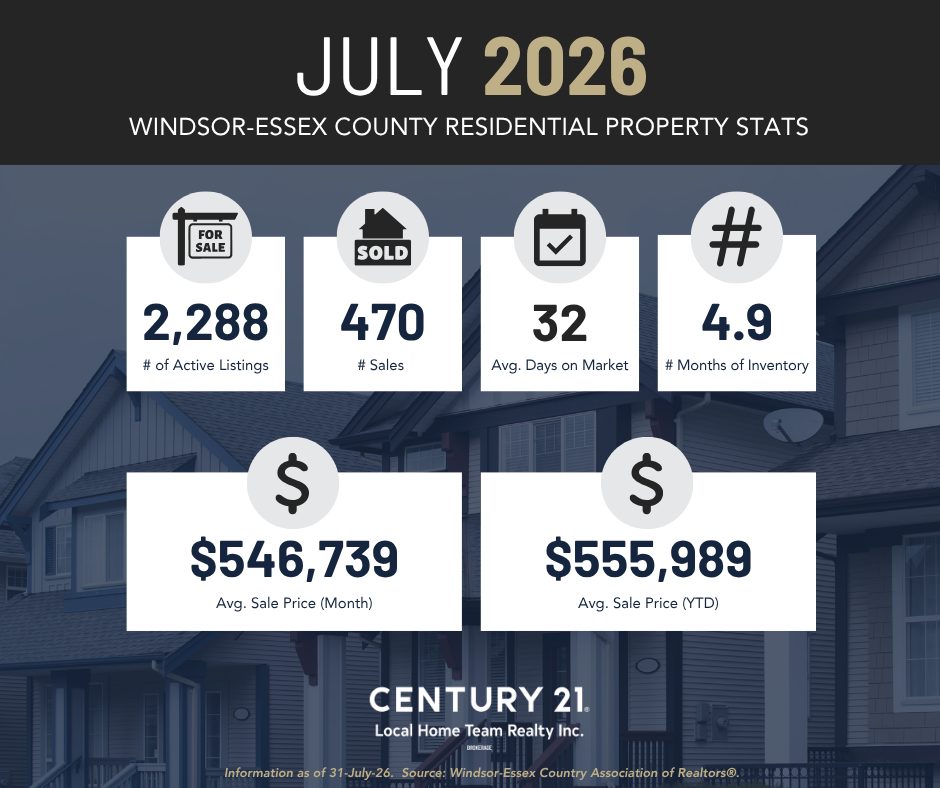
As we move through the heart of summer, the market is behaving much as we’d expect.
Local Real Estate Market Update: August 2026
-
A modest decline in both new listings and sales
-
Slightly longer average days on market
-
A small increase in months of inventory
-
A slight decline in the average sale price
While market fundamentals remain relatively stable, several broader economic factors continue to influence buyer and seller confidence.
-
The opening of the Gordie Howe International Bridge, bringing long-term economic benefits to our region.
-
Ontario’s new HST relief on qualifying new homes is now in effect and beginning to influence the local new construction market.
-
Variable mortgage rates from many A lenders remain below 4% for owner-occupied properties.
-
Markets have remained relatively strong, supporting consumer confidence.
-
Ongoing tariff and trade uncertainty, along with continued geopolitical tensions in the Middle East.
-
Canadian bond yields have been trending higher, which may place upward pressure on fixed mortgage rates if that trend continues.
Cody Kraus
Broker | Owner
c: 519.322.7105
e: cody.kraus@century21.ca