Facebook
 X
 Pinterest
 Copy Link
10 Simple Ways to Make Your Home Feel More Expensive (Without Spending Thousands)

You don’t need a full renovation (or a luxury budget) to make your home feel more expensive, polished and inviting.
In fact, many of the details that create a high-end look are surprisingly affordable. Whether you’re preparing to sell or want to enjoy your space a little more, here are 10 simple ways to make your home feel more expensive!
1. Upgrade Your Lighting
Lighting is one of the easiest ways to change the feel of a room.
Replace outdated fixtures with clean, modern designs and choose warm white LED bulbs (around 2700K–3000K) for a softer, more welcoming glow. If possible, layer your lighting with table lamps or floor lamps instead of relying on a single overhead fixture.
A well-lit room almost always feels larger, warmer and more expensive.
2. Hang Curtains Higher and Wider
One of the oldest designer tricks is also one of the most effective.
Instead of mounting curtain rods directly above the window, install them closer to the ceiling and extend them beyond the window frame. This creates the illusion of taller ceilings and larger windows, making the room feel more open.
3. Refresh the Paint
Few improvements deliver as much value for as little cost as fresh paint.
Neutral colours help create a bright, clean backdrop that appeals to almost everyone. Even if you love bold colours, repainting worn walls can instantly make your home feel newer and better maintained.
4. Replace Small Hardware
You interact with cabinet handles, drawer pulls, and door hardware every day, but they’re often overlooked.
Updating these small details with matching finishes throughout your home creates a more cohesive, custom appearance without requiring a major renovation.
5. Declutter Your Surfaces
Luxury homes rarely feel crowded.
Clear off kitchen counters, entry tables and bathroom vanities, leaving only a few intentional decorative pieces. A little empty space allows your home (and its best features) to stand out.
6. Add Oversized Artwork
Large-scale artwork often has a greater impact than several smaller pieces.
Choose artwork that complements your space and gives each room a clear focal point. You don’t have to spend a fortune; frame an oversized print, browse local artists, or repurpose a large canvas and create your own statement piece. A single bold piece of art can instantly make a room feel more polished and thoughtfully designed.
7. Refresh Your Landscaping
First impressions begin before anyone walks through the front door.
Trim shrubs, edge gardens, spread fresh mulch and keep the lawn maintained. Adding a few colourful seasonal planters near your entrance can dramatically improve curb appeal with minimal investment.
8. Create a Consistent Colour Palette
Homes feel more luxurious when rooms flow naturally from one space to the next.
That doesn’t mean every room has to look identical, but keeping paint colours, flooring and finishes consistent helps create a calm, cohesive feel throughout the home.
9. Update Soft Furnishings
Sometimes it’s the finishing touches that make the biggest difference.
Fresh throw pillows, textured blankets, new towels or updated bedding can instantly refresh a room without replacing the furniture itself.
10. Focus on Cleanliness
Nothing says “well cared for” quite like a spotless home.
Clean windows, polished mirrors, dust-free baseboards and sparkling kitchens and bathrooms can make even an older home feel (and smell!) fresh and inviting.
Creating a home that feels more expensive isn’t about spending more… it’s about making thoughtful improvements that enhance comfort, style and functionality.
Whether you’re planning to stay for years or thinking about selling in the future, these simple updates can make your home feel more expensive while improving comfort and appeal.
If you’re wondering which improvements will have the greatest impact on your home’s value in today’s Windsor-Essex market, we’d love to connect you with one of our experienced REALTORS®. They can help you prioritize the projects that make the most sense for your home, your budget and your long-term goals.

Kristin Ferreira
Marketing Director
c: 519.999.9788
e: kristin.ferreira@century21.ca
The information provided on this blog is not intended as professional advice and should not be substituted for the guidance of a qualified professional. While we strive to provide accurate and up-to-date information, we make no representations or warranties of any kind, express or implied, about the completeness, accuracy, reliability, suitability, or availability with respect to the blog or the information, products, services, or related graphics contained on the blog for any purpose. Any reliance placed on such information should be independently verified.
Why Some REALTORS® Convert More Leads Than Others

One of the questions I hear most often from REALTORS® is: “How do I convert more leads?”
Most people assume the answer is buying better leads, spending more on advertising, or chasing the latest marketing trend. But in reality, most agents already have opportunities sitting in their CRM, inbox, DMs, or phone.
The challenge isn’t generating more leads… it’s to convert more of the ones you already have.
The good news? Improving your conversion rate usually doesn’t require a bigger marketing budget. It comes down to building better habits, stronger relationships, and consistently delivering value.
Here are 2 things you can start doing right now that WILL help you convert more leads…
1. Become the Expert They Were Hoping to Find
Consumers have access to more information than ever before. They can browse listings, estimate home values, compare neighbourhoods, and even ask AI questions about the market.
What they’re really looking for is someone who can interpret that information and provide expert advice.
The agents who earn the most trust are the ones who never stop learning.
Whether that’s staying current on local market trends, touring new listings, attending industry events, or learning new technology, every bit of knowledge helps you provide more confidence and clarity to your clients.
At our brokerage, ongoing education is a big part of that commitment. Weekly meetings, property tours, and monthly Lunch & Learns help our agents stay informed… not just about the market, but about marketing, technology, AI, communication, and business development.
Knowledge creates confidence.
Confidence builds trust.
Trust converts leads into clients.
2. Learn to Communicate the Way Your Client Wants
Every client communicates differently.
Some want every detail. Others just want the highlights.
Some appreciate a phone call, while others would rather receive a quick text.
Some make decisions quickly. Others need time to think things through.
The best agents recognize these differences and adapt their communication accordingly.
One way we’ve helped our agents develop this skill is through Colour Communication Profiles, which focus on understanding your own communication style before learning how to connect more effectively with others.
When you become more self-aware, you ask better questions, listen more effectively, and create stronger relationships… regardless of your client’s communication style.
Converting more leads usually isn’t about spending more money. It’s about becoming a better professional…
- Understand your clients’ motivation.
- Continue learning your market.
- Follow up consistently.
- Communicate in ways that build trust.
- Most importantly, take action.
At Century 21 Local Home Team Realty, we believe great brokerages don’t just help agents find more opportunities… they help them make the most of the opportunities they already have. That’s why we invest heavily in coaching, education, collaboration, and practical training designed to help our agents grow their businesses with confidence.
Because in the end, the best lead conversion strategy isn’t another marketing tactic. It’s becoming the kind of REALTOR® people are excited to recommend!

Len Filiault
Broker of Record
c: 519.890.5045
e: len.filiault@century21.ca
The information provided on this blog is not intended as professional advice and should not be substituted for the guidance of a qualified professional. While we strive to provide accurate and up-to-date information, we make no representations or warranties of any kind, express or implied, about the completeness, accuracy, reliability, suitability, or availability with respect to the blog or the information, products, services, or related graphics contained on the blog for any purpose. Any reliance placed on such information should be independently verified.
Are You Paying Fees or Receiving Value?

When REALTORS® are considering a real estate brokerage, the first question is often: “What are your fees?”
It’s an important question… But it may not be the most important one when choosing a real estate brokerage.
The better question is: “What am I getting in return?”
Because every brokerage costs something, whether it’s a commission split, transaction fee, desk fee, franchise fee, or monthly charge, there is always a cost.
The real question is whether those costs help you build a better business.
The Industry Has Changed
Years ago, brokerages were built around mentorship, training, and support. New agents learned directly from experienced professionals and had people they could turn to when challenges arose.
As the industry evolved, many brokerages shifted toward a model that offered higher commission splits but less hands-on support.
For experienced agents, that can work well.
But for many REALTORS®, something important was lost along the way:
- Mentorship
- Training
- Collaboration
- Community
- Business-building support
A Brokerage Should Help You Grow
At Century 21 Local Home Team, we believe a brokerage should be more than a place to hang your license… It should help you build a business.
That’s why our focus is on helping agents:
- Scale their time
- Grow their income
- Improve their skills
- Build stronger client relationships
- Create long-term success
We don’t just want agents to close more transactions. We want them to build careers they love!
Focus on What Matters Most
The highest-value activities in real estate are simple:
- Meeting clients
- Showing homes
- Negotiating deals
- Building relationships
Too many agents spend their time buried in administrative tasks that don’t generate income.
Our systems, support staff, training, and resources are designed to help agents focus on what they do best while we help support the rest.
Culture Matters
Real estate can be a lonely business.
That’s why we’ve intentionally built a culture of collaboration.
Through weekly meetings, Lunch & Learns, training sessions, caravan tours, and ongoing support, our agents have access to the experience and knowledge of an entire team.
When challenges arise, you’re not figuring it out alone… You’re surrounded by people who want to see you succeed.
Success Looks Different for Everyone
Not every agent wants the same thing.
Some want to build large teams… Some want to become top producers. Others want a successful business that provides more time with family and friends.
There is no single definition of success.
Our job is to help agents achieve their goals, whatever they may be.
SO, Are You Paying Fees or Receiving Value?
Before choosing a real estate brokerage, ask yourself:
- Will I receive meaningful support?
- Will I continue learning and growing?
- Will I have access to leadership when I need help?
- Will this brokerage help me become more productive?
- Will I be better a year from now because I joined?
Those answers matter far more than a few percentage points on a commission split.
At Century 21 Local Home Team, we believe relationships matter more than transactions, and a brokerage should be a partner in your success.
Because the goal isn’t to find the cheapest brokerage… The goal is to find the brokerage that helps you build the business and life you want.
Questions, curiosity, or just looking to connect? …our door is always open!

Cody Kraus
Broker | Owner
c: 519.322.7105
e: cody.kraus@century21.ca
The information provided on this blog is not intended as professional advice and should not be substituted for the guidance of a qualified professional. While we strive to provide accurate and up-to-date information, we make no representations or warranties of any kind, express or implied, about the completeness, accuracy, reliability, suitability, or availability with respect to the blog or the information, products, services, or related graphics contained on the blog for any purpose. Any reliance placed on such information should be independently verified.
Stop Buying Leads. Start Building a Referral Machine.

Every REALTOR® wants more leads.
It’s one of the most common questions I hear:
“Where should I spend my marketing dollars?”
Google Ads?
Facebook Ads?
Realtor.ca?
Google Business Profile?
Referral websites?
The truth is that every one of these can generate business.
But not all leads are created equal.
The most successful agents don’t spend their careers buying leads. They gradually build a business where referrals become their primary source of clients.
Think of lead generation like a funnel.
As you move down the funnel, the cost per lead decreases, trust increases, conversion rates improve, and your business becomes far more profitable.
STAGE 1: PAY-PER-CLICK ADVERTISING
This is where many new agents begin. You pay every time someone clicks your advertisement, hoping they eventually become a client.
The advantages:
- Immediate traffic
- Scalable
- Great for testing markets
- Excellent if you have strong follow-up systems
The disadvantages:
- Expensive
- Highly competitive
- Low trust
- Many prospects are simply shopping around
You’re essentially introducing yourself to complete strangers.
These leads can absolutely become clients, but they require significant nurturing.
STAGE 2: THIRD-PARTY REFERRAL PLATFORMS
The next step is to earn business because others have had positive experiences with you.
When someone finds dozens of genuine reviews, detailed client stories, and a strong online reputation, they’re much warmer than someone clicking an advertisement. You’ve already established credibility before the first conversation.
The cost of acquiring these leads is typically much lower because your reputation is doing much of the selling for you.
The lesson? Every successful transaction should generate another review.
Your reviews become marketing assets that continue working long after the deal has closed.
STAGE 3: REALTOR.CA LEADS
Many consumers begin their home search on Realtor.ca.
When buyers request information about a property, they’re demonstrating genuine interest and are often further along in the buying process than someone who clicked a social media advertisement.
While these leads still require strong follow-up, they generally represent people actively engaged in the market.
Speed of response and excellent customer service become critical differentiators.
STAGE 4: GOOGLE BUSINESS PROFILE
This is where your online presence really begins to work for you.
When someone searches:
- “Best REALTOR near me”
- “Real estate agent in Windsor”
- “Homes for sale in Essex”
Your Google Business Profile can place you directly in front of motivated consumers.
By this point you’ve likely accumulated:
- Positive Google reviews
- Helpful photos
- Consistent updates
- Questions and answers
- Local credibility
Unlike paid advertising, much of this traffic is organic. Google begins rewarding consistency and trust.
STAGE 5: YOUR DATABASE
This is where good agents become great agents.
Every client you’ve helped…
Every open house visitor…
Every neighbour you’ve met…
Every community connection…
Every past inquiry…
They all belong in your database.
Your CRM isn’t simply a contact list.
It’s your future business.
Consistent communication through newsletters, market updates, phone calls, client appreciation events, and valuable content keeps you top of mind.
People can’t refer you if they forget about you.
STAGE 6: REFERRALS
This is the goal.
When your phone rings because someone says, “My friend told me I had to call you.”
You’ve reached the most valuable lead source in real estate.
Referral clients arrive with trust already established.
They’re less focused on interviewing multiple agents.
They’re more loyal.
They negotiate less on commission.
They convert at significantly higher rates.
And best of all… They often refer someone else.
This creates a cycle where every satisfied client helps generate the next one.
THE FUNNEL NEVER STOPS…
The reality is that most successful REALTORS® use every stage of the funnel.
They may still run Google Ads.
They still collect reviews.
They optimize their Google Business Profile.
They respond quickly to Realtor.ca inquiries.
They consistently communicate with their database.
And they deliver an experience worthy of referrals.
The difference is where most of their business comes from. New agents often rely heavily on paid advertising. Experienced agents rely increasingly on relationships.
The ultimate goal isn’t to become better at buying leads. It’s to build a reputation so strong that your best leads come from people who already trust you before you’ve even said hello.
That’s how sustainable real estate businesses are built.
If your marketing strategy is built entirely around buying leads, it may be time to rethink your approach.
The most successful REALTORS® don’t simply generate more leads… they build systems that turn every client into the next opportunity. By investing in your reputation, consistently communicating with your database, and delivering an exceptional client experience, you can gradually shift your business from chasing strangers to attracting referrals.
If you’d like to learn how to build a lead funnel that becomes more profitable year after year, I’d love to chat.
Whether you’re a new agent looking to build momentum or an experienced REALTOR® ready to reduce your reliance on paid advertising, let’s grab a coffee and talk about strategies that create lasting success.
Your next client shouldn’t always have to be purchased. Sometimes, they just need to remember your name.
Len Filiault
Broker of Record
c: 519.890.5045
e: len.filiault@century21.ca
The information provided on this blog is not intended as professional advice and should not be substituted for the guidance of a qualified professional. While we strive to provide accurate and up-to-date information, we make no representations or warranties of any kind, express or implied, about the completeness, accuracy, reliability, suitability, or availability with respect to the blog or the information, products, services, or related graphics contained on the blog for any purpose. Any reliance placed on such information should be independently verified.
Local Real Estate Market Update: July 2026
It’s hard to believe we’ve entered the third quarter of 2026!
From a Windsor–Essex and Chatham-Kent real estate update perspective, Q2 wrapped up much the same way 2025 ended.
Year-to-date, new listings are down 2.4%, sales are down 5%, and average sale prices have softened slightly, from approximately $572k at this time last year to $557.5k today (a 2.5% decline).
Overall, market conditions continue to point to a balanced market, with 4.7 months of inventory. That said, market conditions continue to vary by segment, with noticeable differences between freehold homes and condos, as well as the entry-level and luxury markets.
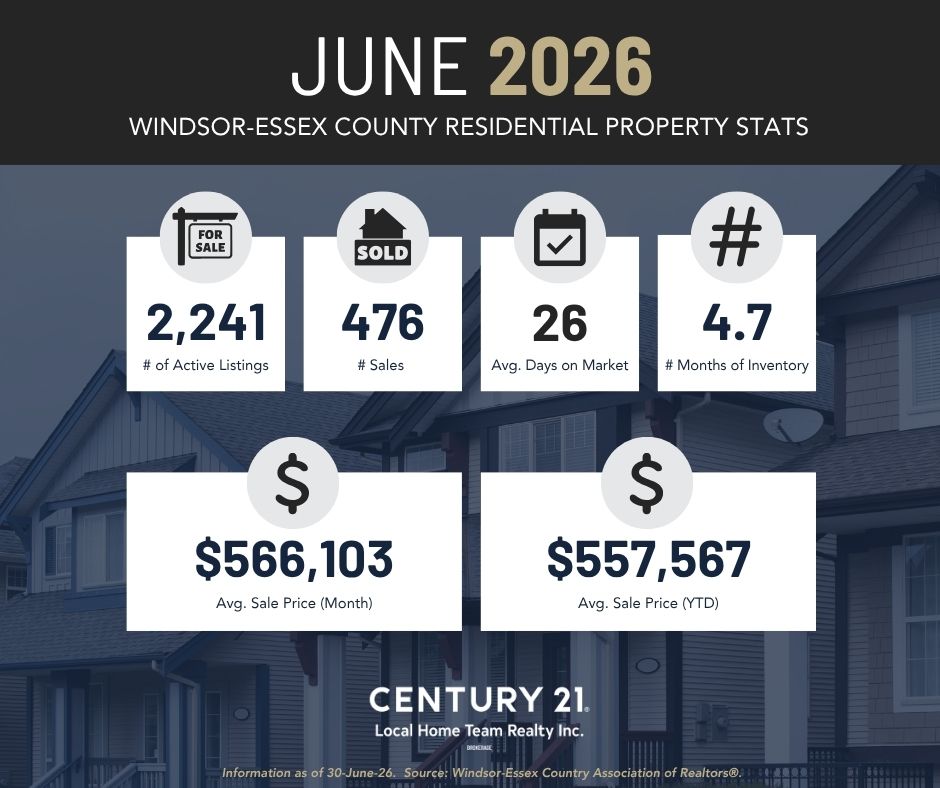
It’s important to remember that these are overall market trends. Your neighbourhood, price range, and property type may be telling a very different story.
If you’re thinking about buying or selling in Windsor–Essex and Chatham-Kent, let’s take a closer look at your specific market. I’d be happy to walk you through comparable sales, current competition, and local market conditions so you can make informed decisions based on what’s happening where it matters most.
Cody Kraus
Broker | Owner
c: 519.322.7105
e: cody.kraus@century21.ca
The information provided on this blog is not intended as professional advice and should not be substituted for the guidance of a qualified professional. While we strive to provide accurate and up-to-date information, we make no representations or warranties of any kind, express or implied, about the completeness, accuracy, reliability, suitability, or availability with respect to the blog or the information, products, services, or related graphics contained on the blog for any purpose. Any reliance placed on such information should be independently verified.
A Mortgage Broker & 2 Real Estate Agents Walk into a Bar…

A few weeks ago, I attended The Loonie Hour Investor Series at the Rivoli in Toronto, and it was fantastic.
As a real estate broker and economics junkie, I couldn’t ask for a better lineup. The featured panel included three of Canada’s most recognizable real estate and finance voices: Ron Butler (The Angry Mortgage Podcast), Dan Foch (The Canadian Real Estate Investor Podcast), and Steve Saretsky (The Loonie Hour Podcast).
The discussion covered everything from interest rates and housing trends to investing, inflation, and where opportunities may exist moving forward.
Here were my three biggest takeaways:
1. The case for variable-rate mortgages may be strengthening.
The panel made a compelling argument that variable rates could become increasingly attractive. With Canada’s economic challenges and debt levels, the bond market may continue to experience volatility. At the same time, much of today’s inflation pressure appears tied to energy costs rather than housing. Raising rates in that environment could create additional strain on the broader economy.
Of course, every client’s situation is unique, but it’s a reminder that the mortgage conversation is becoming more nuanced than simply asking, “What’s the lowest rate?”
2. The market may be near the bottom, but that doesn’t necessarily mean a boom is around the corner.
There was a general feeling that many Canadian markets may be at or near their cyclical lows. That said, nobody on stage was predicting a dramatic surge in prices.
The more likely scenario? A period of sideways movement.
As agents, that’s an important distinction. We can’t build our businesses around hoping for a hot market. Whether the market is up, down, or flat, there are always people buying, selling, investing, and relocating. The opportunity is still there for those who stay informed, adaptable, and engaged.
3. Investors may be starting to look beyond traditional asset classes.
After the correction in real estate values that began in 2022 and several years of strong stock market performance, much of it fueled by enthusiasm around AI, some investors are beginning to question where value exists going forward.
One area that generated discussion was food production and agriculture. Regardless of economic cycles, people still need to eat. That creates long-term demand for agricultural land, food processing facilities, and related infrastructure.
Whether you agree with the thesis or not, it’s a good reminder that opportunities often emerge in sectors that aren’t getting all the headlines.
Why Should Real Estate Agents Care?
Three reasons:
- Our clients look to us for perspective, not just property information.
- We need to think about diversifying our own investments and long-term wealth strategies.
- Many of the industries shaping the future economy, such as housing, agriculture, logistics, manufacturing, and infrastructure, are all connected to real estate in one way or another.
The more we understand what’s happening beyond our local market, the better equipped we are to serve our clients and identify opportunities.
And as for the mortgage broker and two real estate personalities who walked into a bar…
They didn’t tell many jokes, but they did leave me with a few ideas worth sharing!
CLICK HERE to check out a really great podcast that took place the next day with Ben Rabidoux of Edge Analytics.
Cody Kraus
Broker | Owner
c: 519.322.7105
e: cody.kraus@century21.ca
The information provided on this blog is not intended as professional advice and should not be substituted for the guidance of a qualified professional. While we strive to provide accurate and up-to-date information, we make no representations or warranties of any kind, express or implied, about the completeness, accuracy, reliability, suitability, or availability with respect to the blog or the information, products, services, or related graphics contained on the blog for any purpose. Any reliance placed on such information should be independently verified.
Is Building a Custom Home Right for You?

For many people, building a custom home represents the ultimate real estate dream.
Imagine finding the perfect lot, designing a floor plan tailored to your family’s lifestyle, selecting every finish, and creating a home that reflects your personality from the ground up.
The ability to customize every detail is certainly appealing. However, the reality of building a home is often far more complex, time-consuming, and expensive than many people initially expect.
The good news? Building isn’t the only path to owning your dream home.
Purchasing an older home or buying a newly constructed home from a reputable builder can often provide many of the same benefits: modern layouts, updated finishes, energy efficiency, and reduced maintenance, while significantly reducing the stress, risk, and time commitment associated with managing a custom build.
Before deciding which route is best for you, it’s important to understand both the rewards and challenges that come with building.
WHAT DOES IT TAKE TO BUILD A HOME?
Building a home requires careful planning, budgeting, coordination, and countless decisions along the way.
From purchasing land and obtaining permits to securing financing, coordinating trades, and navigating construction timelines, there are many moving parts that must come together successfully.
Even with careful planning, unexpected challenges can arise, including:
- Material price increases
- Construction delays
- Permit and approval issues
- Site preparation challenges
- Labour shortages
- Design changes during construction
For some homeowners, the experience is incredibly rewarding and well worth the effort. For others, managing a major construction project can become overwhelming.
That’s why it’s important to evaluate your budget, timeline, lifestyle, and comfort level before deciding whether building is the right choice.
PROS OF BUILDING A CUSTOM HOME
✓ Brand-new construction with minimal maintenance
✓ Modern layouts and improved energy efficiency
✓ Ability to personalize finishes and design choices
✓ Designed specifically around your family’s needs
✓ No competing in multiple-offer situations
CONS OF BUILDING A CUSTOM HOME
X Higher overall cost than many comparable resale homes
X Construction timelines can range from 6 to 24 months
X Potential for unexpected cost overruns
X Landscaping, driveways, appliances, and upgrades add up quickly
X Construction financing can be more complicated than a traditional mortgage
WHAT DOES IT COST TO BUILD A 2,000 SQ. FT. HOME IN WINDSOR-ESSEX COUNTY?
The following example provides a realistic planning framework for a typical mid-tier custom home build in Windsor-Essex County in 2026…
Assumptions
- 2,000 sq. ft. finished living space
- Unfinished basement
- Attached garage
- Municipal water and sewer services
- Standard rectangular floor plan
- Mid-tier finishes and fixtures
- Average site conditions
- Professional trades throughout
- Average 2026 labour and material pricing
Estimated Construction Cost
Current construction costs typically range between $350 and $400 per square foot for a quality custom home.
At $350 per square foot:
2,000 sq. ft. × $350 = $750,000
This figure represents construction and interior finishes only and does not include land acquisition or other project-related costs.
Additional Costs to Consider
- Serviced Building Lot
- Legal Fees & Closing Costs
- Construction & Interior Finishes
- Contingency Reserve
- Utility Connections
- Landscaping
- Driveway & Walkways
- Appliances
- Builder Upgrades & Change Orders
!! DON’T FORGET ABOUT CONTINGENCIES !!
One of the most common mistakes homeowners make is budgeting only for expected costs.
Construction projects frequently encounter unforeseen expenses, making a contingency reserve essential. Setting aside at least 5% of your total project budget can help absorb unexpected costs without creating unnecessary financial stress.
Eligible first-time home buyers may qualify for federal GST/HST new housing rebates, potentially reducing costs by tens of thousands of dollars, depending on the project and eligibility requirements.
Always consult your accountant, lawyer, or tax professional to determine which programs may apply to your situation.
A REALISTIC BUDGET
When all costs are considered, including land acquisition, legal expenses, construction, site development, finishes, and contingency planning, a realistic budget for a quality 2,000-square-foot custom home in Windsor-Essex County is often:
$850,000 – $950,000+
Luxury finishes, larger lots, complex architectural designs, and challenging site conditions can increase costs significantly.
SO… IS BUILDING “WORTH IT”?
For many homeowners, absolutely.
The ability to create a home that perfectly fits your family’s needs, lifestyle, and long-term goals can make the investment worthwhile.
However, building a home is rarely a simple project. Success often comes down to realistic expectations, careful planning, and surrounding yourself with the right professionals from the very beginning.
Whether you’re just beginning to explore the idea of building or actively searching for land, our team can help guide you through the process.
We can assist with:
- Finding and evaluating building lots
- Understanding zoning and development restrictions
- Reviewing servicing requirements
- Connecting you with lenders, builders, architects, engineers, and trades
- Providing local market insight throughout the process
Building a custom home can be one of the most rewarding decisions you’ll ever make, but it starts with having the right information.
If you’re considering building in Windsor-Essex County, we’d be happy to answer your questions and help determine whether it’s the right move for you.

Justin Kirouac
Real Estate Agent
c: 519.999.5346
e: justin.kirouac@century21.ca
The information provided on this blog is not intended as professional advice and should not be substituted for the guidance of a qualified professional. Costs are estimates only and should not be relied upon for budgeting or construction planning without consulting qualified professionals. While we strive to provide accurate and up-to-date information, we make no representations or warranties of any kind, express or implied, about the completeness, accuracy, reliability, suitability, or availability with respect to the blog or the information, products, services, or related graphics contained on the blog for any purpose. Any reliance placed on such information should be independently verified.
3 Things You Should Do Before Listing Your Home This Month

Thinking about listing your home? Before it hits the market, a few strategic steps can make a meaningful difference in how quickly it sells and for how much.
The reality is, today’s buyers are more informed and selective than ever. The homes that stand out aren’t always the most updated… they’re the ones that are presented the best.
Here are three things you should focus on before listing this month:
1. Declutter and Simplify Your Space
Buyers aren’t just purchasing a home, they’re trying to picture their life in it.
Too much furniture, personal items, or clutter can make spaces feel smaller and more distracting. By simplifying each room, you allow the home’s layout and features to stand out.
Focus on:
- Clearing off countertops and surfaces
- Removing excess furniture
- Minimizing personal photos and décor
A clean, neutral space creates a stronger first impression—both online and in person.
2. Handle the Small Repairs You’ve Been Putting Off
Minor issues can send the wrong message to buyers. Even small things like a dripping faucet or chipped paint can make a home feel less maintained.
Before listing, take care of:
- Loose handles or fixtures
- Scuffed walls or baseboards
- Leaky faucets or running toilets
- Burnt-out light bulbs
These are relatively inexpensive fixes, but they go a long way in building buyer confidence.
3. Focus on First Impressions (Curb Appeal Matters)
Your home’s exterior is the first thing buyers see, and it sets the tone for everything that follows.
Simple updates can make a big impact:
- Tidy up landscaping and add fresh mulch
- Power wash walkways and siding
- Clean the front door and add a welcoming touch
A strong first impression doesn’t just attract more buyers; it can influence how they perceive the value of the home before they even step inside.
You don’t need a full renovation to prepare your home for the market. In most cases, it’s the small, strategic improvements that create the biggest impact.
By focusing on presentation, condition, and first impressions, you can position your home to stand out, and sell with confidence.
Thinking About Listing This Month?
Preparing your home for sale can feel overwhelming, but it doesn’t have to be.
The good news is that you don’t need to navigate it alone. We have the experience, trusted local contacts, and proven systems to help make the process as smooth and stress-free as possible. From deciding what improvements are worth making to connecting you with the right professionals, we’ll help you focus on the things that will have the biggest impact.
Every home is different, and every seller’s situation is unique. That’s why we start with a conversation and build a plan that’s tailored to your goals.
If you’re considering a move, we’d be happy to put you in touch with one of our Agents who can put together a strategy and answer any questions you may have… no pressure, just honest advice.
Kristin Ferreira
Marketing Director
c: 519.999.9788
e: kristin.ferreira@century21.ca
The information provided on this blog is not intended as professional advice and should not be substituted for the guidance of a qualified professional. While we strive to provide accurate and up-to-date information, we make no representations or warranties of any kind, express or implied, about the completeness, accuracy, reliability, suitability, or availability with respect to the blog or the information, products, services, or related graphics contained on the blog for any purpose. Any reliance placed on such information should be independently verified.
Local Real Estate Market Update: June 2026

When people ask us how our local real estate market is these days, our answer is often, “It depends on the price range.”
It may not be the most exciting market we’ve ever experienced, but it presents opportunities for both buyers and sellers.
If you’re wondering what today’s market means for you, we’d be happy to help. Whether you’re considering buying, selling, investing, or simply exploring your options, reach out to our team for a conversation about your specific situation and the opportunities available in today’s market.
Cody Kraus
Broker | Owner
c: 519.322.7105
e: cody.kraus@century21.ca
The information provided on this blog is not intended as professional advice and should not be substituted for the guidance of a qualified professional. While we strive to provide accurate and up-to-date information, we make no representations or warranties of any kind, express or implied, about the completeness, accuracy, reliability, suitability, or availability with respect to the blog or the information, products, services, or related graphics contained on the blog for any purpose. Any reliance placed on such information should be independently verified.
The 3 Traits of Truly Successful REALTORS®

Almost everyone knows a REALTOR®.
A friend. A cousin. A former co-worker. Someone from high school who suddenly starts posting listings and open houses online.
Real estate is one of those careers that attracts people from all walks of life because, on the surface, it looks exciting, flexible, and full of opportunity.
And to be fair… it can be all of those things.
But what many people do not realize is how difficult the industry can actually be.
Depending on the source, many industry studies and reports suggest that somewhere between 75% and 87% of new real estate agents leave the business within their first five years. (nowbam.com)
That is a staggering number.
So what separates the agents who struggle from the ones who build long, successful careers?
It is not always who is the smartest.
It is not always who has the biggest social media following.
And it is definitely not always who has the most experience when they start.
In my experience, the agents who truly thrive in this business tend to share three very specific traits…
1. Personable
At its core, real estate is still a relationship business.
Yes, technology matters.
Marketing matters.
Systems matter.
But people still want to work with someone they trust.
The most successful REALTORS® are not always the loudest people in the room. They are the people who make clients feel comfortable, heard, understood, and cared for.
Being personable is not about being “salesy.”
In fact, the best agents often feel the least like salespeople.
They listen more than they talk.
They ask thoughtful questions.
They remember details about people’s lives.
They communicate clearly.
They stay calm during stressful situations.
Buying or selling a home is emotional. Clients remember how you made them feel long after they forget the square footage or mortgage rate discussion.
Great REALTORS® understand they are not just helping clients buy homes.
They are helping people navigate major life moments.
And that requires emotional intelligence as much as industry knowledge.
2. Self-Starters
Real estate offers freedom, but freedom can be dangerous without discipline.
There is no boss standing over your shoulder telling you to make calls, follow up with leads, preview homes, improve your marketing, or stay current with the market.
Successful REALTORS® understand that motivation alone is not enough. They create structure, routines, and habits even when nobody is watching.
They prospect when business is slow.
They follow up when others give up.
They continue showing up during difficult markets.
The reality is this business can feel very rewarding one month and very humbling the next. The agents who survive long-term are the ones who can push themselves forward without needing constant external pressure.
Self-starters understand something important:
Success in real estate is rarely built in massive moments. It is built in small, consistent actions repeated over years.
3. Lifelong Learners
The real estate industry changes constantly.
Markets shift.
Interest rates move.
Technology evolves.
Consumer expectations change.
Regulations and forms are updated regularly.
The agents who stop learning usually start falling behind.
The best REALTORS® I know are naturally curious people. They are constantly improving their skills, learning new technology, studying negotiation strategies, understanding marketing trends, and adapting to changing client expectations.
Ironically, some of the most successful agents are also the ones most willing to admit they do not know everything.
That mindset matters.
Because the moment someone believes they have nothing left to learn is usually the moment their growth stops.
Today, continuous learning is easier than ever. Podcasts, YouTube, coaching, books, AI tools, webinars, and online training have made professional growth incredibly accessible.
The question is no longer:
“Can you access knowledge?”
The real question is:
“Are you willing to pursue it consistently?”
Real estate is one of the few careers where almost anyone can enter the industry, but very few build lasting success.
The agents who thrive long-term are usually not relying on luck.
They are personable professionals who genuinely care about people.
They are self-starters who stay disciplined.
And they are lifelong learners who continue growing.
Those 3 traits of successful REALTORS® may sound simple.
But consistently living them out every single day?
That is what separates a good REALTOR® from a truly great one.
Len Filiault
Broker of Record
c: 519.890.5045
e: len.filiault@century21.ca